
Quick Takeaways:
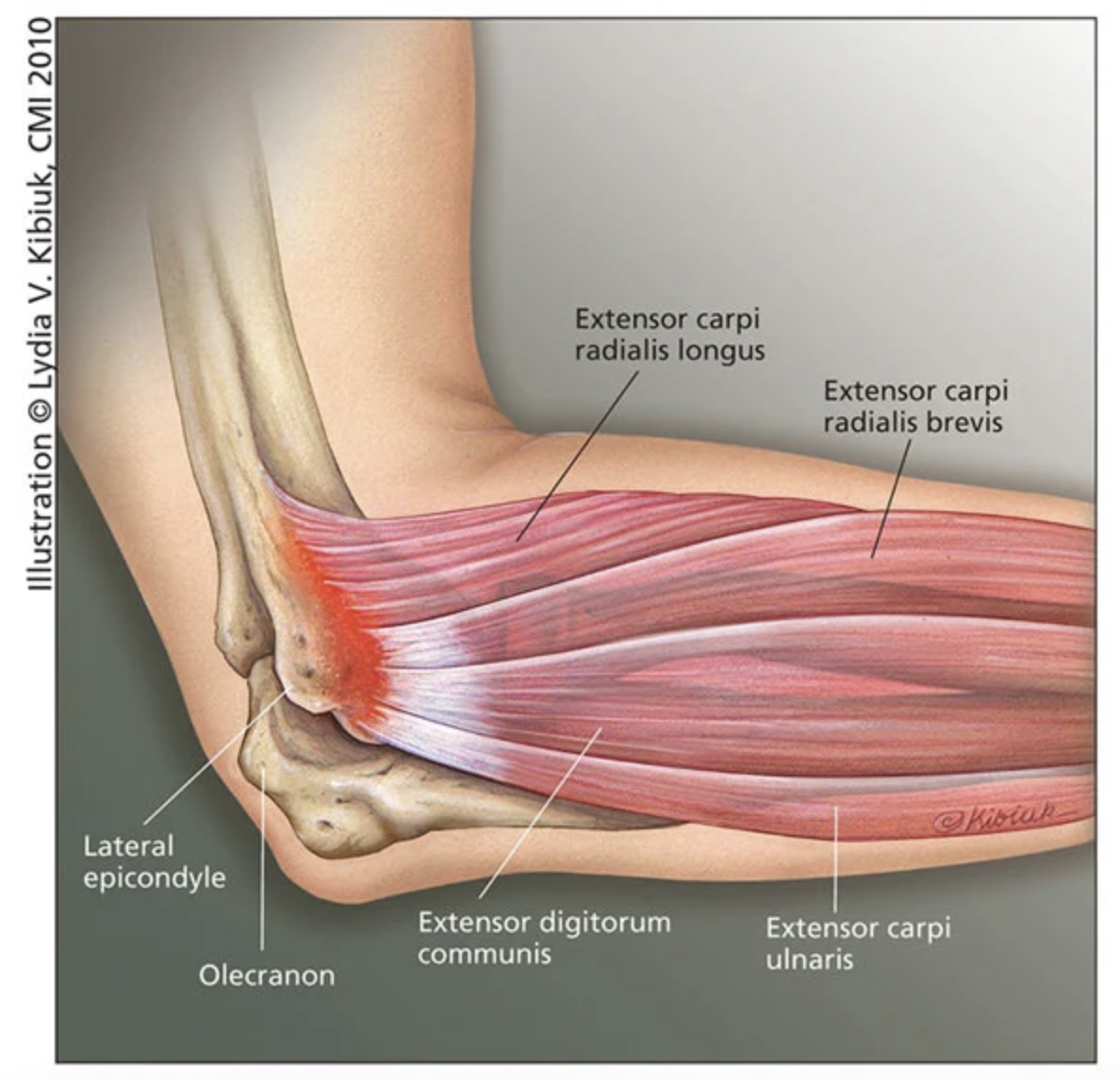
Lateral epicondylitis is caused by irritation of the tendon that connects to the outer elbow. Our extensor muscles connect into this tendon.
We use our extensor muscles to a large degree with gripping activities such as climbing which is sometimes the cause of tendon irritation.
Pure rest is usually not the solution to this tendon irritation. Targeted loading of the tendon is the solution.
Options for self assessment and beginning PT exercises are suggested below.
Lateral Elbow Pain in Climbers: Why the Outside of Your Elbow Hurts
As I am sure you may know, us climbers use our forearms to a large degree while climbing and training. Any time that we grip something, whether it be a climbing hold or milk jug, various muscles on either side of our forearm contract to stabilize our wrist and fingers. Oftentimes, we think of our strong finger flexor muscles on the palm side of our forearm doing the brunt of the work with gripping, but our extensor muscles also play a large role in gripping.
Our forearm extensor muscles are located on the backside of our forearms AKA the opposite side from the palm. When we grip, crimp, or grab, our extensors contract to stabilize our wrists and fingers and increase the force we can produce with our finger flexors. With that being said, as climbers, we use our forearm extensors to a large degree.
What is Lateral Epicondylitis?
The extensor muscles connect into the outer AKA “lateral” portion of our elbow via a tendon. It is the tendon that causes the irritation in the case of lateral epicondylitis. The tendon can then get stuck in a cycle where it does not fully restore its tolerance to load, rendering it susceptible to irritation as we grip with climbing and daily activities. Things that can cause lateral epicondylitis can include overuse, weakness into the forearm extensors, or certain climbing mechanics that place extra stress on the lateral elbow and forearm extensors.
The term “Tennis Elbow” is often used interchangeably with lateral epicondylitis as this lateral tendon irritation injury can be common in tennis players from large forces being placed on the extensor tendon from backhand hits. However, this injury is not isolated to tennis players and affects various populations, which is why we are moving away from this terminology.
Signs & Symptoms
Pain on the outer portion of the elbow following gripping activities or climbing
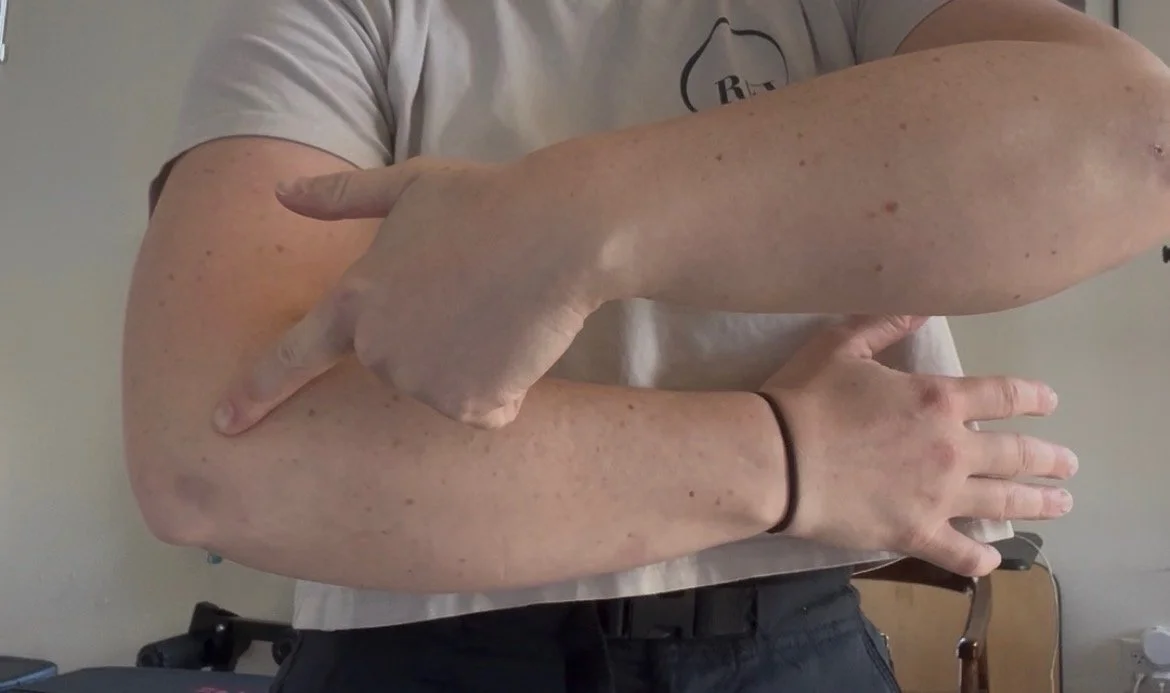
Pain on the outer portion of the elbow following gripping activities or climbing
Reduced grip strength
Tenderness to palpation or pressure on the outer portion of the elbow
“Start up pain” such as you notice it when you begin climbing and then it may fade as you warm up, but then can become apparent after your climbing session
Self Assessment
Below are a few signs and symptoms that you can look for as well as a few assessment techniques. Assessing lateral epicondylitis can be a bit tricky on your own as there are many muscles across the top of the forearm that can be the culprit connecting into the tendon.
Assessment Techniques
To assess for tendon pain, we test some of the muscles that connect into the tendon. To test these muscles, we must ask them to contract and pull on the tendon.
● Resisted Wrist Extension
○ Support your forearm on a table or surface and bend the backside of your hand up towards the sky
○ Hold your hand in this position and then use your other hand to try to move the palm side of your hand down towards the surface. Try to resist the force of your hand from moving it!
○ “Positive” Test: reproduction of your pain or symptoms on the outer portion of your elbow
● Resisted Middle Finger Extension
○ Support your forearm on a table or surface and lift your middle finger up
○ Hold your finger in this position and then use your other hand to try to move your middle finger down towards the surface. Try to resist the force of your hand from moving your finger!
○ “Positive” Test: reproduction of your pain or symptoms on the outer portion of your elbow
● Resisted Forearm Supination
○ Support your forearm on a table or surface with your thumb up
○ Hold your hand in this position and then use your other hand to try to move the palm side of your hand down towards the surface. Try to resist the force of your hand from moving your hand!
○ “Positive” Test: reproduction of your pain or symptoms on the outer portion of your elbow
Reminder: in less severe cases or sometimes in cases with climbers, as we have pretty strong forearms, some of these self tests may not have enough load across the tendon to produce symptoms. You may try these tests with dumbbells to add a bit more weight to further assess symptoms. It is possible that other muscles or nerves further up the chain may be involved or elbow ligaments, so, when in doubt, come in for an evaluation!
Why Rest Doesn’t Always Work
When we work with climbers suffering from lateral epicondylitis, the first thing we often hear is that they tried to rest for a few days or weeks to allow irritation to subside. While decreasing overall intensity and volume of climbing in acute phases is often required to manage symptoms, it does not address the fact that the tendon is still less tolerant to load. Despite decreased symptoms that usually follow a period of rest, the tendon is still not able to tolerate the demands we place on it when climbing, usually causing the pain to come back as intensity is ramped back up.
So…how do I allow the tendon to begin to tolerate load and the demands of climbing intensity again? Targeted tendon loading!
Two Tendon Loading Exercises That We Frequently Use
The below exercises may serve as a nice basis for getting started. It is OKAY to push into some symptoms while performing PT exercises.
Pain guidelines for beginning to load: 2-3/10 pain is okay while performing the following exercises as long as:
● It does not increase your resting pain beyond this for more than ~24 hrs and symptoms roughly drop back to baseline within this time frame
● Your wrist is not becoming irritated. These exercises do load across the wrist which is not a bad thing! However, wrists can sometimes be sensitive to new loads, so just keep an eye out.
Suggestions:
● Begin with performance of these exercises 3-4x/wk on non-consecutive days
● Begin with performance of these on non-climbing or gripping intensive day in order to spread out the volume of loading early on
Wrist Extension Isometric Hold
● 8-10 lbs can be a nice place to start as long as symptoms remain within pain guidelines
● Hold for 15-20 seconds, then rest 30 seconds; repeat this 4-5 times (1 set)
● Rest 2 minutes and then perform another set (2 sets in total)
● Keep your middle knuckle in line with the middle of your forearm
Forearm supination
● 5-8 lbs can be a nice place to start as long as symptoms remain within pain guidelines
● Use a heavy pan or adjustable weight (or a long PVC pipe if it weighs enough)
● Have your elbow supported on a surface or bent to 90 degrees by your side as shown in the video
○ Thumbs up position to palms down position and then back to thumbs up position
○ Slowly lower down to the palms down positions
● Perform 3 sets of 10-12
● Rest 1-2 minutes between sets
When It Might Not Be Lateral Epicondylitis
There are many anatomical structures that cross the lateral elbow or contribute to the function of this portion of the elbow. There are also mechanisms of injury that are more likely to affect other elbow structures aside from the extensor tendon. If anything below resonates with your symptoms or mechanism of injury, it may not be lateral epicondylitis:
● Numbness, tingling, or radiating pain the arm, forearm, or hand/fingers
● A fall on an outstretched arm
● Pain or irritation on the inner portion of the elbow
When To Seek Help for Suspected Lateral Epicondylitis
I will not lie, lateral epicondylitis can be a tricky one because:
● There are many anatomical structures that cross over the lateral elbow
● It requires consistent loading across the lateral elbow - it is a patient process as tendons can sometimes take up to 5-6 + months to fully remodel and become more tolerant to loads
● It requires load, intensity, and/or technique management with climbing and gripping related activities
If the following is you, we recommend seeking the attention of a medical professional:
● You are going through a cycle of resting and climbing and pain has continued for more than 3-4 weeks
● You feel like you are gambling with your climbing or training and are unsure what will cause things to get worse or better
● You have tried some suggested PT exercises and still are struggling with symptoms
Contact Rev PT
At Rev PT, we want to get you back to the activities you love, whether it is climbing or another passion. We frequently work with clients suffering from lateral elbow pain and can provide you with a plan to get you back to doing what you love with less pain and worry.
You can schedule an initial evaluation or email jen@revslc.com to schedule a free, remote 15 minute injury screen to help you decide your next best course of action.
The above information should not serve as direct medical advice and you should seek professional medical attention if you are consistently struggling with elbow pain or an injury.